Category

Recent News

Drug-Induced Psychoses May Signal Substantial Schizophrenia Risk

Psychcongress.com 6 November 2019
Family First Comment: “More than a third of people who experienced psychosis with cannabis use later transitioned to schizophrenia, according to a systematic review and meta-analysis.”

More than a third of people who experienced psychosis with cannabis use later transitioned to schizophrenia, according to a systematic review and meta-analysis published online in Schizophrenia Bulletin.

Similarly, schizophrenia transition risk among people who experienced psychosis from hallucinogen or amphetamine use was also considerable.

“These findings have important implications for mental health care and services. Substance-induced psychoses are common reasons for seeking mental health care,” a Psychiatric News Alert quoted from the study. “Yet despite this, people with substance-induced psychoses are often excluded from early psychosis services or assertive mental health care due to a perception that these are benign or self-limiting conditions.”

Cannabinoids Not Justified as Mental Health Treatment, Study Says

The meta-analysis spanned 50 studies which provided 79 estimates of transition to schizophrenia among 40,783 people with substance-induced, brief, or atypical psychoses. Some 25 of the studies, which included 34,244 people, had substance-specific estimates.

Overall, 25% of people who experienced substance-induced psychosis transitioned to schizophrenia, researchers reported. The rate of transition for people who transitioned to schizophrenia after brief, atypical, or not-otherwise-specified psychoses was 36%.

The highest rates of transition to schizophrenia were associated with cannabis-induced psychosis (34%), hallucinogen-induced psychosis (26%), and amphetamine-induced psychosis (22%), according to the study. Transition rates were lower when drug-induced psychosis was associated with opioids (12%), alcohol (10%), and sedatives (9%).

“Substance-induced psychoses associated with cannabis, hallucinogens, and amphetamines have a substantial risk of transition to schizophrenia,” researchers wrote, “and should be a focus for assertive psychiatric intervention.”
https://www.psychcongress.com/article/drug-induced-psychoses-may-signal-substantial-schizophrenia-risk


facebook_icon

Scientists Discover New Link Between Marijuana Smoking And Testicular Cancer Risk

Science Alert 4 December 2019
Family First Comment: Another good reason to avoid dope
“The study found that men who smoked one marijuana cigarette, or joint, daily for 10 years or more had an estimated 36 percent increased risk of developing testicular cancer compared with men who had never smoked the substance.”

There’s new evidence that a daily marijuana-smoking habit could increase your risk of testicular cancer.

study published Wednesday in JAMA Network Open found that men who smoked one marijuana cigarette, or joint, daily for 10 years or more had an estimated 36 percent increased risk of developing testicular cancer compared with men who had never smoked the substance.

To come to their conclusion, researchers analysed 25 studies that looked at the link between marijuana use and testicular cancer, lung cancer, oral cancer, and head and neck cancer.

Though the researchers found no association between regular marijuana use and lung, neck, or oral cancer, they did find that regular weed smoking over many years could heighten a man’s risk of testicular cancer.

Smoking marijuana releases cancer-causing substances
Like smoking cigarettes, smoking marijuana releases carcinogens, or substances that can increase a person’s risk of developing cancer.

That’s because cannabis, the plant marijuana is derived from, is like any other plant in that it burns and releases smoke when you light it, according to Dr. Jeffrey Chen, the director of the UCLA Cannabis Research Initiative.

“When you combust any plant, you’re creating significantly more carcinogens,” Chen previously told Insider.
READ MORE: https://www.sciencealert.com/men-who-smoke-marijuana-daily-may-be-more-likely-to-get-testicular-cancer

signup-rollKeep up with family issues in NZ.
Receive our weekly emails direct to your Inbox.

Cannabis lollipops, soft drinks and protein powder could be on the market for Kiwis following cannabis referendum

NZ Herald 4 December 2019
Family First Comment: “But it is confectionery items like chocolates, lollipops, gummy lollies and soft drinks, that have raised the ire of Family First, with spokesman Bob McCoskrie saying such products could be targeted at children. Opposition lobby group Say Nope to Dope, of which Family First is a part, has run giant billboards throughout the year against the referendum, including a series featuring a deep green gummy bear smoking a joint.”

If the international market is anything to go by getting high off lollipops, gummy lollies, soft drinks and even protein powder could be an option following next year’s cannabis referendum.

The Government yesterday announced the draft Cannabis Legalisation and Control Bill, designed to govern the recreational cannabis market should it come into effect.

The legislation specifies a minimum age of 20 to use or purchase a recreational cannabis product, and prohibits consumption in public spaces, among many other measures.

But two aspects have raised more questions than others – the inclusion of edible products, and a 14g carry limit.

In legal cannabis markets overseas cannabis edibles have gone well past the traditional brownies, to everything from protein powder, beer, and even THC-infused beef jerky.

But it is confectionery items like chocolates, lollipops, gummy lollies and soft drinks, that have raised the ire of Family First, with spokesman Bob McCoskrie saying such products could be targeted at children.

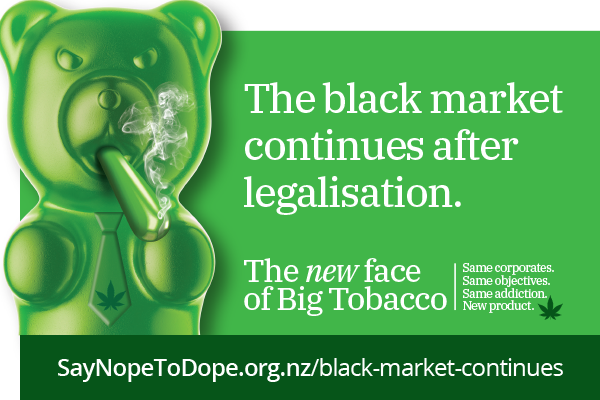
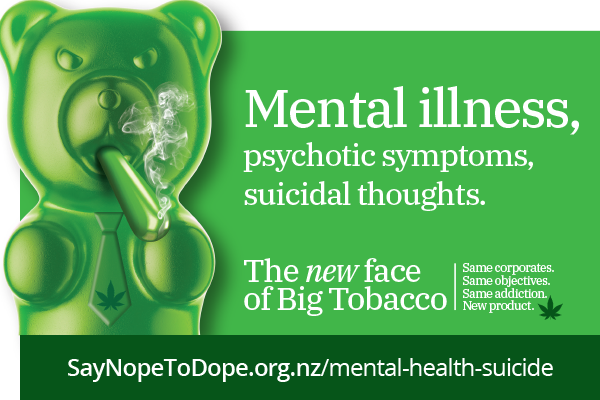
Opposition lobby group Say Nope to Dope, of which Family First is a part, has run giant billboards throughout the year against the referendum, including a series featuring a deep green gummy bear smoking a joint.

National’s drug and alcohol spokeswoman Paula Bennett said she was concerned about youth still accessing cannabis.

“Young people are still going to try it, but they will be getting it from the black market.”

In introducing the draft legislation, which will be open to submissions, Justice Minister Andrew Little said the primary objective was to “reduce overall cannabis use and limit the ability of young people to access cannabis”.
READ MORE: https://www.nzherald.co.nz/nz/news/article.cfm?c_id=1&objectid=12290788

twitter follow us

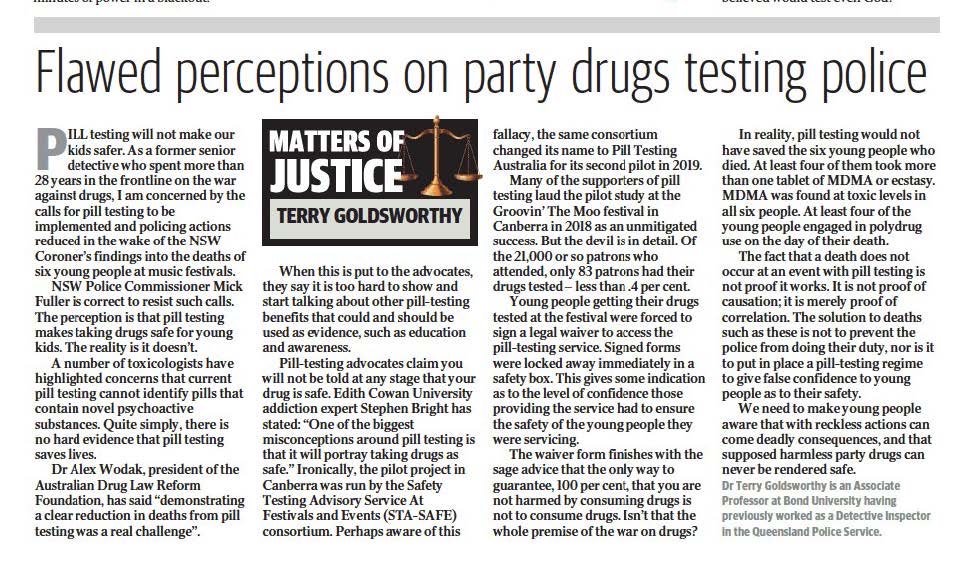
Dr Terry Goldsworthy: Flawed Perceptions on Party Drugs Testing Police

Courier Mail (Aust) November 2019
Pill testing will not make our kids safer. As a former senior detective who spent more than 28 years in the frontline on the war against drugs, I am concerned by the calls for pill testing to be implemented and policing actions reduced in the wake of the NSW Coroner’s findings into the deaths of six young people at music festivals.

NSW Police Commissioner Mike Fuller is correct to resist such calls. The perception is that pill testing makes taking drugs safe for young kids. The reality is it doesn’t.

A number of toxicologists have highlighted concerns that current pill testing cannot identify pills that contain novel psychoactive substances. Quite simply, there is no hard evidence that pill testing saves lives.

Dr Alex Wodak, president of the Australian Drug Law Reform Foundation, has said “demonstrating a clear reduction in deaths from pill testing was a real challenge”.

When this is put to the advocates, they say it is too hard to show and start talking about other pill-testing benefits that could and should be used as evidence, such as education and awareness.

Pill-testing advocates claim you will not be told at any stage that your drug is safe. Edith Cowan University addiction expert Stephen Bright has stated: “One of the biggest misconceptions around pill testing is that it will portray taking drugs as safe.” Ironically, the pilot project in Canberra was run by the Safety Testing Advisory Service At Festivals and Events (STA-SAFE) consortium. Perhaps aware of this fallacy, the same consortium changed its name to Pill Testing Australia for its second pilot in 2019.

Many of the supporters of pill testing laud the pilot study at the Groovin’ The Moo festival in Canberra in 2018 as an unmitigated success. But the devil is in detail. Of the 21,000 or so patrons who attended, only 83 patrons had their drugs tested – Less than .4 per cent.

Young people getting their drugs tested at the festival were forced to sign a legal waiver to access the pill-testing service. Signed forms were locked away immediately in a safety box. This gives some indication as to the level of confidence those providing the service had to ensure the safety of the young people they are servicing.

The waiver form finishes with the sage advice that the only way to guarantee, 100 per cent, that you are not harmed by consuming drugs is not to consume drugs. Isn’t that the whole premise of the war on drugs?

In reality, pill testing would not have saved the six young people who died. At least four of them took more than one tablet of MDMA or ecstasy. MDMA was found at toxic levels in all six people. At least four of the young people engaged in ploydrug use on the day of their death.

The fact that a death does not occur at an event with pill testing is not proof it works. It is not proof of causation; it is merely proof of correlation. The solution to deaths such as these is not to prevent the police from doing their duty, nor is it to put in place a pill-testing regime to give false confidence to young people as to their safety.

We need to make young people aware that with reckless actions can come deadly consequences, and that supposed harmless party drugs can never be rendered safe.

Dr Terry Goldsworthy is an Associate Professor at Bond University having previously worked as a Detective Inspector in the Queensland Police Service.

Don’t Become the Next Colorado

Big Marijuana wants to go “Full Colorado” in states all across the nation. They are sugar coating the impact on kids and denying the staggering costs of legalization. Don’t let your state be the next Colorado.

California cannabis industry sending SOS to state leaders

CNN 26 November 2019
Family First Comment: Remember how Chlöe and Drug Foundation say the black market and gangs will disappear under legalisation??
“California is indeed home to the world’s largest cannabis market, totaling close to $12 billion in estimated sales. But here’s the rub: $8.7 billion of that is changing hands in the illicit market.”

About 170 years after California’s gold rush came the promise of the green rush.

California’s legalization of cannabis for adult recreational use was expected to be massive. In 2016, industry investors claimed sales could top $6.5 billion by 2020.

And as 2019 comes to a close, California is indeed home to the world’s largest cannabis market, totaling close to $12 billion in estimated sales. But here’s the rub: $8.7 billion of that is changing hands in the illicit market.

Now, members of California’s cannabis industry are sending an S.O.S. to the state capitol, saying they’re struggling to compete against black market operators who don’t have to meet stringent regulations or pay taxes and fees. They’re urging leaders to make swift regulatory changes or risk the collapse of their emerging industry.

“The hard truth is that until legislative changes are made, our industry will continue to wither away,” said Michael Steinmetz, CEO of cannabis distributor Flow Kana, which recently joined a growing list of California cannabis firms that have cut their workforces.

Following the job cuts, which were first reported by the Sacramento Bee and described as an an “epidemic” of layoffs, Steinmetz cobbled together an informal coalition of more than a dozen leading companies and business associations to lobby the state.

California cannabis businesses that have cut their workforces or scaled back growth plans say their woes aren’t limited to the capital markets turbulence and the growing pains ricocheting through the broader cannabis industry. Their challenges, they say, are homegrown: California has too few licensed cannabis businesses, too much taxation and overly onerous regulation.
READ MORE: https://edition.cnn.com/2019/11/26/business/california-cannabis-industry-layoffs/index.html
signup-rollKeep up with family issues in NZ.
Receive our weekly emails direct to your Inbox.

Mike Hosking: Canada’s example shows the dangers of legalising cannabis

NewsTalk ZB 28 November 2019
Family First Comment: “The legalisation in Canada had the same sort of ideological bollocks wrapped around it as the pro dopers are pedalling here. It’s a health issue, we want to offer support, we want to control the market, we want the bad guys out of the business. One year on none of it has happened. In fact, quite the opposite, the illegal side of the trade has flourished.”
#saynopetodope

I think we can be somewhat grateful to Canada for legalising cannabis a good year or so ahead of us. They’re making a complete hash – no pun intended – of it.

This week’s news is the massive over supply: the market went nuts, grew it like there was no tomorrow, so now they have warehouses full of it. And you know what happens to the price when the supply side is out of kilter – yes, it crashes.

That’s the trouble when it comes to drugs. Cheap drugs then lead to greater uptake, which is fine if its fruit and veggies but not if it’s the sort of product that leads to dependence and psychosis.

The legalisation in Canada had the same sort of ideological bollocks wrapped around it as the pro dopers are pedalling here. It’s a health issue, we want to offer support, we want to control the market, we want the bad guys out of the business.

One year on none of it has happened. In fact, quite the opposite, the illegal side of the trade has flourished.

And here’s the simple truth about government vs private enterprise when it comes to business of which pedalling dope is: the private sector always wins. It wins on agility, creativity, flexibility and street smarts.

They’re not driven by policy, by politics, by agencies, by bureaucracy, they’re driven by a bottom line: you want it, they got it.

So not only do the Canadians have two and a half years’ worth of supply in warehouses. They also have the psychological things they didn’t think of.
READ MORE: https://www.newstalkzb.co.nz/on-air/mike-hosking-breakfast/opinion/mike-hosking-canadas-example-shows-the-dangers-of-legalising-cannabis/

twitter follow us

“Netherlands at risk of becoming a narco-state”

Dutch Minister of Justice: “The Netherlands is becoming a narco-state”
Voice of Europe 29 August 2019
Family First Comment: “Tackling the drug economy and the crime that accompanies it requires endurance, joint dedication and long-term effort.”
Sounds like a war on drugs, doesn’t it.

Following the release of a report on organized crime in Amsterdam, Ferd Grapperhaus, the country’s Minister of Justice and Security said that drug-related crime must be dealt with or the Netherlands risks becoming a “narco-state”.

According to a report from Algemeen Dagblad, the drug economy in Amsterdam, which serves as the center for the multi billionaire euro cocaine trade, has become utterly unmanageable.  Police officers worry that the battle against the world of organized drug crime has been lost.

Although the Netherlands lacks the public resources to strengthen the police force, Grapperhaus said that he’s currently searching for ways to allocate funds to combat the problem because if nothing is done then soon the country risks devolving into a narco-state, De Telegraaf reports.

“Then there would be a minister with sunglasses and no longer someone who provides democratic accountability,” said Minister Grapperhaus.

“I have already made 100 million available to combat the problem,” he added.

According to Grapperhaus, the kind of crime where the upper and the underworld get mixed up must be stopped.
READ MORE: https://voiceofeurope.com/2019/08/dutch-minister-of-justice-the-netherlands-is-becoming-a-narco-state/

facebook_icon

Canada awash with excess dope

Canada racks up 400-tonne cannabis mountain after production binge
NZ Herald 25 November 2019
Family First Comment: This is the supposed ‘success’ of legalisation….
“Cannabis inventories came to almost 400 tonnes at the end of August, enough to cover two-and-a-half years of demand. Meanwhile the price of the drug has slumped as legal and illegal cannabis distributors grapple for market share. The stockpile suggests that one year after Canada became the first large economy to allow nationwide recreational use of cannabis, the industry has overestimated how much the country’s pot-smokers can burn through — and underestimated the illegal market’s ability to respond to competition.”
Don’t do it, New Zealand.
#saynopetodope

Warehouses in Canada are piled high with unsold marijuana after cannabis producers overestimated demand for the drug, which was legalised a year ago.

Across the country, cannabis inventories came to almost 400 tonnes at the end of August, enough to cover two-and-a-half years of demand, according to the latest government data.

Meanwhile the price of the drug has slumped as legal and illegal cannabis distributors grapple for market share.

The stockpile suggests that one year after Canada became the first large economy to allow nationwide recreational use of cannabis, the industry has overestimated how much the country’s pot-smokers can burn through — and underestimated the illegal market’s ability to respond to competition.

“There is a huge surplus of cannabis just for domestic demand,” said Matt Bottomley, analyst at Canaccord Genuity.

Canopy Growth, a company listed in Toronto under the ticker WEED, said it harvested 40,570kg and wrote down C$15.9m ($12m) worth of inventory in the three months to the end of September.
READ MORE: https://www.nzherald.co.nz/index.cfm?objectid=12288036&ref=twitter

signup-rollKeep up with family issues in NZ.
Receive our weekly emails direct to your Inbox.

‘We don’t know what we don’t know’ on medicinal cannabis

Stuff co.nz 24 November 2019
Family First Comment: the Faculty of Pain Medicine (part of Australian and New Zealand College of Anaesthetists) was also advising doctors not to prescribe medicinal cannabis, as research showed its effects to be “disappointing”. “At the moment the Faculty of Pain Medicine is saying the data is saying don’t do it,” 

A Marlborough GP says the prescription of medicinal cannabis could be premature.

The Medicinal Cannabis Scheme is expected to be operational at the beginning of next year, enabling the commercial cultivation and manufacture of medicinal cannabis in New Zealand.

Medical cannabis company Puro has secured two sites in Marlborough, with plans to start commercial cultivation when the “law allows”.

But Renwick Medical Centre GP Dr Buzz Burrell said the science has not caught up with the public debate on the prescription of medicinal cannabis.

“The pure science of cannabis is so in its infancy, it’s scary,” he said.

“When we’re talking about prescribing a product that has not undergone phase-one trialling, we don’t know what we don’t know.

“It’s almost fascinating that we are being asked by society to jump the gun and start prescribing something which hasn’t completed phase-one trials yet.

“We owe it to the public to be as cautious [with medicinal cannabis] as with anything else we prescribe.”

He said most drugs prescribed to the general public underwent four phases of trials before being released.

Burrell said the Faculty of Pain Medicine (part of Australian and New Zealand College of Anaesthetists) was also advising doctors not to prescribe medicinal cannabis, as research showed its effects to be “disappointing”.

“At the moment the Faculty of Pain Medicine is saying the data is saying don’t do it,” he said.

“Chronic persistent pain to a certain degree affects 20 per cent of the adult population.”

“If we promise these one in five people that this will alleviate their pain and suffering, that’s absolutely cruel.”

He hoped the Medicinal Cannabis Scheme, which would legislate a licensing regime and standards of quality, would reveal the products were safe to prescribe, particularly for chronic pain.

“It would be wonderful to have a safe product we can prescribe, but at the moment I can’t say that with confidence,” he said.
READ MORE: https://www.stuff.co.nz/national/health/117559141/we-dont-know-what-we-dont-know-on-medicinal-cannabis

twitter follow us